Hellraiser II: Hellbound doesn’t simply continue the story from the first film—it throws open the gates and drags us much deeper into the twisted world that Clive Barker created. If the original movie introduced us to the Cenobites and the mysterious Lament Configuration, this sequel asks, “What lies beyond the box?” The answer is both fascinating and absolutely disturbing.
As we continue our Hellraiser Dialogue, this second film begins answering some questions while introducing even more mysteries. We finally get a glimpse into the infamous Labyrinth, learn more about the Cenobites’ origins, and discover that there are far worse things than simply opening a puzzle box. The mythology is growing, and I’m all for it.
Welcome to the Labyrinth
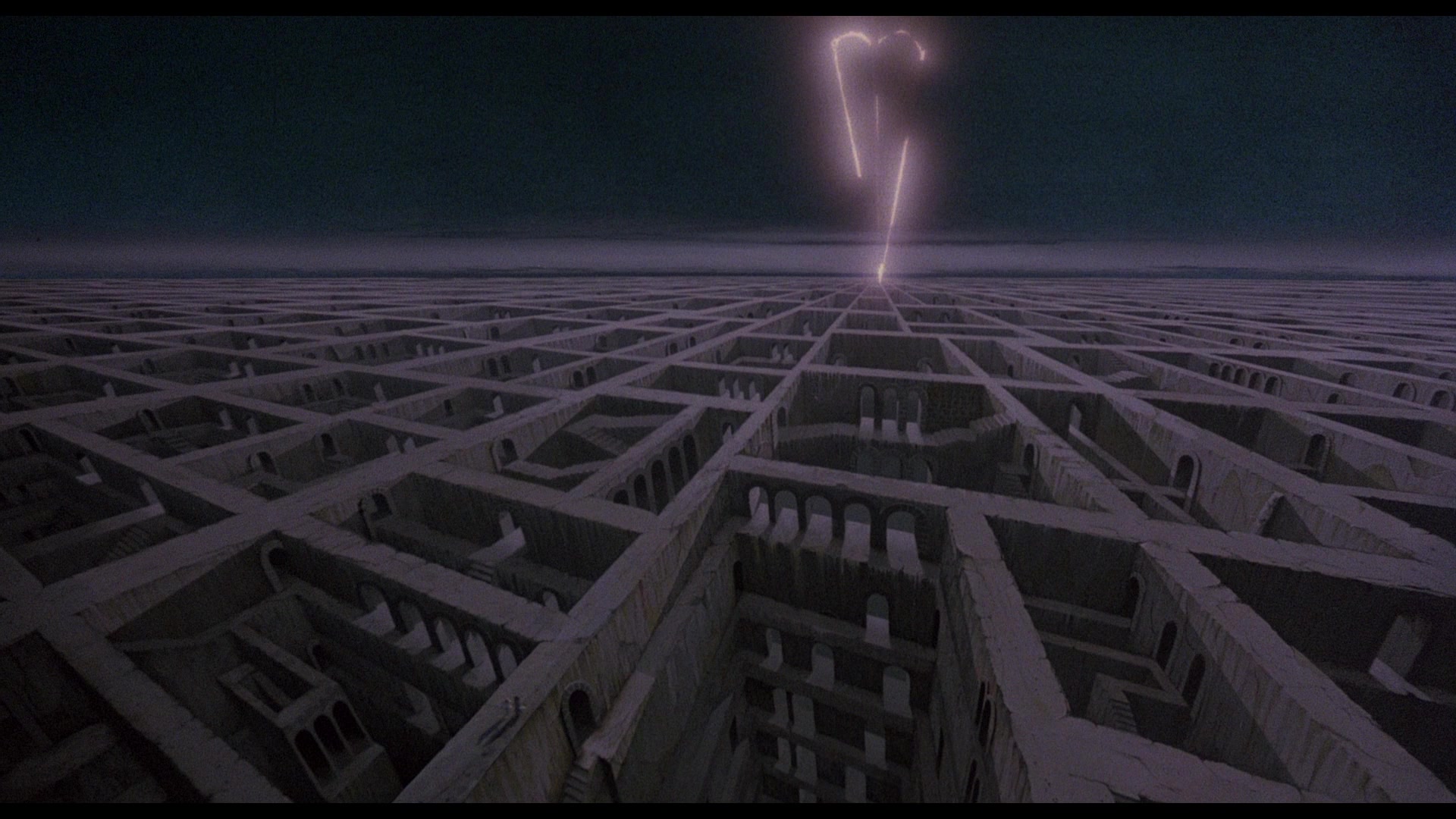
One of the biggest additions in Hellraiser II is the Labyrinth itself. This strange dimension isn’t just “Hell” in the traditional sense. Instead, it feels like an endless maze designed around temptation, obsession, suffering, and personal torment. Every hallway seems to have a purpose, yet nothing feels completely logical. Oddly enough, that’s what makes it work.
The Labyrinth is confusing, surreal, and dreamlike while somehow still making enough sense that you can follow Kirsty’s journey. It almost feels like you’re wandering through someone else’s nightmare where the rules constantly change.
The massive gothic architecture, endless corridors, and impossible rooms give the movie a much larger scale than the first film ever attempted.
Julia Takes Center Stage
This time, Frank Cotton takes a backseat as Julia Cotton becomes the film’s primary villain.
After being resurrected through blood once again, Julia slowly rebuilds herself much like Frank did in the original. The movie almost mirrors the first film, but with Julia manipulating those around her instead.
There’s also an interesting feeling throughout the movie that power comes at a terrible price. Nearly every resurrection, transformation, or supernatural advancement requires sacrifice. Blood becomes currency. Lives are traded for power. It almost feels like a dark ritual every single time someone seeks more than they were ever meant to possess. That recurring idea helps make Hellraiser II feel more mythological rather than simply another slasher sequel.
The Cenobites Become Even Stranger
One thing I absolutely appreciated was learning more about the Cenobites. The first film presents them as mysterious beings who appear when summoned. This sequel slowly peels back that mystery and reveals they were once human. That revelation somehow makes them even more unsettling.
These aren’t monsters born from evil—they’re transformed souls who experienced unimaginable suffering before becoming servants of Leviathan. They no longer understand where pain ends and pleasure begins, making them both terrifying and oddly tragic.
Pinhead continues to steal nearly every scene he’s in, but this movie finally gives the other Cenobites a little more personality and history as well. The designs remain wonderfully grotesque. They’re disturbing without relying solely on gore, and every Cenobite feels uniquely crafted instead of looking like generic monsters.
The Lament Configuration Opens Bigger Doors
The Lament Configuration also becomes much more than a cursed puzzle box.
Rather than simply summoning the Cenobites, it’s now clear that the box serves as a key between worlds. It’s less of an object and more of an invitation to a realm governed by Leviathan and its horrifying order.
We still don’t know everything about it—and I’m hoping the later films continue expanding the mythology—but it feels like we’re beginning to understand why so many people are obsessed with solving it.
Curiosity remains the greatest danger.
The Practical Effects Keep Improving
The practical effects continue to improve the second time around. There’s noticeably more ambition behind the creature work, body transformations, and elaborate makeup effects. Flesh stretches, skin peels away, bodies mutate, and victims become grotesque sculptures in ways that were impressive for 1988.
Of course, watching it today does create a few unintentionally funny moments. Some of the torn flesh and rubber prosthetics are obviously fake when viewed with modern eyes. Today’s visual effects can create disturbingly realistic injuries, while these practical effects occasionally resemble rubber masks and buckets of fake blood. Still, there’s something incredibly satisfying about knowing almost everything was physically built on set. The effects have weight and texture that many CGI-heavy horror films still struggle to replicate.
Best Horror Scene: Dr. Channard’s Transformation
Without question, the standout horror sequence belongs to Dr. Channard. Watching Leviathan transform him into a new Cenobite is equal parts fascinating and horrifying. Mechanical devices pierce his body, flesh tears apart, and bizarre surgical instruments permanently fuse into him as he evolves into something no longer human. It’s grotesque body horror at its finest. The sequence perfectly represents what Hellraiser is all about—transcending humanity through unimaginable suffering.
Best Kill: The Mattress Resurrection
One of the most memorable sequences isn’t even a traditional kill.
The infamous mattress scene where a psychiatric patient is manipulated into cutting himself across the stained mattress is absolutely horrifying. As blood pours into the mattress, Julia slowly emerges from beneath it as a skinless corpse, clawing her way back into existence. It’s disgusting. It’s bizarre. And it’s one of the most memorable resurrection scenes in horror history. Even nearly forty years later, it’s difficult to forget.
Final Thoughts
Hellraiser II succeeds because it doesn’t simply repeat the first movie. Instead, it expands nearly everything. The mythology grows larger. The Cenobites become more complex. The Labyrinth offers a surreal new setting. The practical effects become even more ambitious. Julia proves to be a compelling central villain, while Dr. Channard delivers one of the franchise’s most unforgettable transformations.
There are still plenty of unanswered questions surrounding Leviathan, the Labyrinth, and the Lament Configuration, but that’s part of what keeps this series so fascinating. Every movie seems determined to reveal another layer of this bizarre mythology.
As we continue our Hellraiser Dialogue, I’m excited to see where the franchise goes next and how these ideas continue to evolve.
With Hellraiser making its haunted house debut at Halloween Horror Nights this year, I’m even more curious to see how Universal Orlando recreates the Labyrinth, the Cenobites, and some of these unforgettable practical effects inside a walk-through experience.
If the first two films are any indication…
We haven’t even scratched the surface of Hell.