Stephen King stories do not always need supernatural monsters to be terrifying. Sometimes, all King needs is a simple idea, a group of believable characters, and the frightening realization that human beings can create something far worse than any creature. The Long Walkis a perfect example of that.
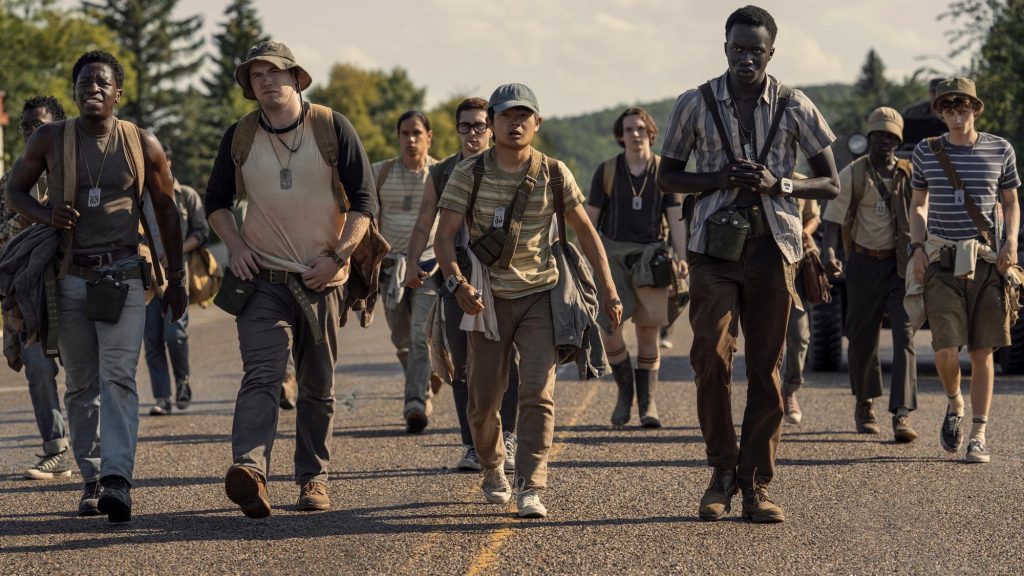
Directed by Francis Lawrence, The Long Walk adapts King’s 1979 novel, which was originally published under his Richard Bachman pseudonym. The story takes place in a dystopian America where young men enter an annual competition with one basic rule: keep walking. Anyone who slows down too many times receives a final warning from the armed soldiers following the group. Only the last remaining walker survives and wins the ultimate prize.
It sounds like a premise that could become repetitive quickly. After all, how do you build an entire movie around people walking down a road?
The answer is surprisingly simple: you make the audience care about the people taking each step.
More Than a Survival Competition
At the center of the movie are Raymond Garraty, played by Cooper Hoffman, and Peter McVries, played by David Jonsson. Their growing friendship gives the movie its emotional foundation. As the walkers become increasingly exhausted, scared, and desperate, their conversations reveal why they entered the competition and what they are trying to leave behind.
Hoffman and Jonsson are both excellent. They make the quieter moments feel just as important as the more brutal scenes. You begin watching the movie because of the deadly competition, but you stay invested because you want these young men to somehow find a way through it together.
That is where the movie feels the most like classic Stephen King. The horror is not limited to what happens when someone stops walking. It comes from watching friendships develop between people who know that only one of them can ultimately survive.
The movie also does a great job of showing the physical and mental damage caused by the Walk. Every blister, stumble, and moment of exhaustion becomes important. The road begins to feel endless, and the repetitive movement creates its own kind of tension. You know someone will eventually fall behind, but you never feel completely prepared when it happens.
Mark Hamill Is Surprisingly Evil as the Major
I was surprised to see Mark Hamill appear as the Major, but he was a great choice for the role.
This is not the heroic and hopeful Mark Hamill many viewers associate with Luke Skywalker. The Major is an evil, intimidating man who treats the Walk as an important national tradition rather than the horrifying execution spectacle that it truly is.
Hamill does not need to constantly shout or dominate every scene. His presence alone reminds the walkers that someone is always watching and controlling their fate. There is a cold confidence in the performance that makes the Major feel even more dangerous.
Hamill has plenty of experience playing villains through his voice work as the Joker, but seeing him bring that darkness into a live-action Stephen King adaptation was still unexpected. Even the younger cast members reportedly kept their distance from him during filming so they could preserve the intimidating relationship between the Major and the walkers.
He is a very evil man, but Hamill plays him extremely well.
How Does It Compare to The Hunger Games, Divergent, and The Maze Runner?
It is almost impossible to watch The Long Walk without thinking about The Hunger Games, Divergent, or The Maze Runner. All four stories follow young people trapped inside dystopian systems controlled by powerful adults. They also explore survival, government manipulation, and what happens when ordinary people are forced to participate in something cruel.
The biggest difference is scale.
The Hunger Games turns its deadly competition into a massive televised spectacle filled with elaborate arenas, political rebellion, and carefully constructed public identities. That connection is especially interesting because The Long Walkdirector Francis Lawrence also directed several movies in the Hunger Games franchise.
Divergent focuses more heavily on social divisions, identity, and discovering where someone belongs within a controlled society. The Maze Runner places its characters inside a mystery that must be solved before they can understand who created the maze and why they were placed inside it.
The Long Walk strips nearly everything away.
There is no complicated arena, maze, faction system, or collection of futuristic gadgets. There is simply a road, a group of walkers, armed soldiers, and the command to keep moving. The simplicity makes it feel more intimate and, in some ways, more disturbing.
The movie is less concerned with building a giant franchise mythology and more interested in what happens inside a person’s mind when exhaustion, fear, and death become unavoidable. It feels smaller than those other dystopian movies, but its emotional impact can feel much larger.
A Great Stephen King Adaptation
The Long Walk is not an easy or uplifting movie. It is bleak, violent, and emotionally exhausting. However, it is also a great movie with strong performances and an idea that becomes increasingly frightening the longer you think about it.
Cooper Hoffman and David Jonsson carry the emotional side of the story, while Mark Hamill delivers one of the movie’s most memorable performances as the Major. The supporting walkers also receive enough personality that they feel like individuals rather than background characters waiting to be eliminated.
Most importantly, the movie understands that the real power of Stephen King’s story does not come from the competition’s rules. It comes from the conversations, friendships, regrets, and moments of humanity shared along the road.
The characters may be forced to keep moving forward, but The Long Walk gives viewers plenty to stop and think about after the journey is over.