There are roller coasters that become favorites because they are smooth, fast or packed with airtime. Then there are rides like X2.
X2 was never really about being comfortable. It was about getting to the top of that lift hill, looking down at a 215-foot drop and realizing the coaster was about to throw you off the edge while your seat decided to flip you in an entirely different direction.
And now, one of the strangest and most influential roller coasters ever built is officially being retired.
Six Flags Magic Mountain announced on September 29 that X2 will permanently close after the attraction had remained shut down since July. Park President Brian Oerding said X2 had welcomed more than 16 million riders since its major 2008 transformation and acknowledged the passionate following the coaster developed over the years.
For coaster fans, this is a big one.
X2 wasn’t just another coaster sitting on Magic Mountain’s skyline. It was a prototype, an experiment and, depending on who you asked after getting off, either one of the greatest roller coasters ever created or complete insanity on rails.
Before X2, There Was X
The story actually begins several years before the name X2 ever appeared.
Arrow Dynamics designed the attraction as the world’s first full-scale 4th Dimension roller coaster. Instead of riders simply following the track like a traditional coaster, the seats were positioned on wings extending outward from the train and could rotate 360 degrees independently as the train moved through the course.
That meant the track could send you one direction while the seats sent your body another.
X began welcoming 2001 season pass holders on December 24, 2001, before officially opening to the general public on January 12, 2002. The coaster was designed by Alan Schilke, who would later become one of the industry’s most recognizable coaster designers.
Even before opening, X proved just how ambitious the concept was. The ride encountered developmental challenges, and its debut was delayed while additional work was performed. A former Magic Mountain maintenance executive later recalled that an early version of the ride was considered too rough and required more work before opening.
But once X finally opened, there really wasn’t anything else like it.
You didn’t simply ride the coaster.
You fought gravity in several directions at once.
X Becomes X2
Six Flags wasn’t finished with the concept.
In 2008, the park invested roughly $10 million into transforming X into X2. The upgrade included lighter trains along with new audio and special effects, essentially turning an already unusual coaster into a full sensory experience.
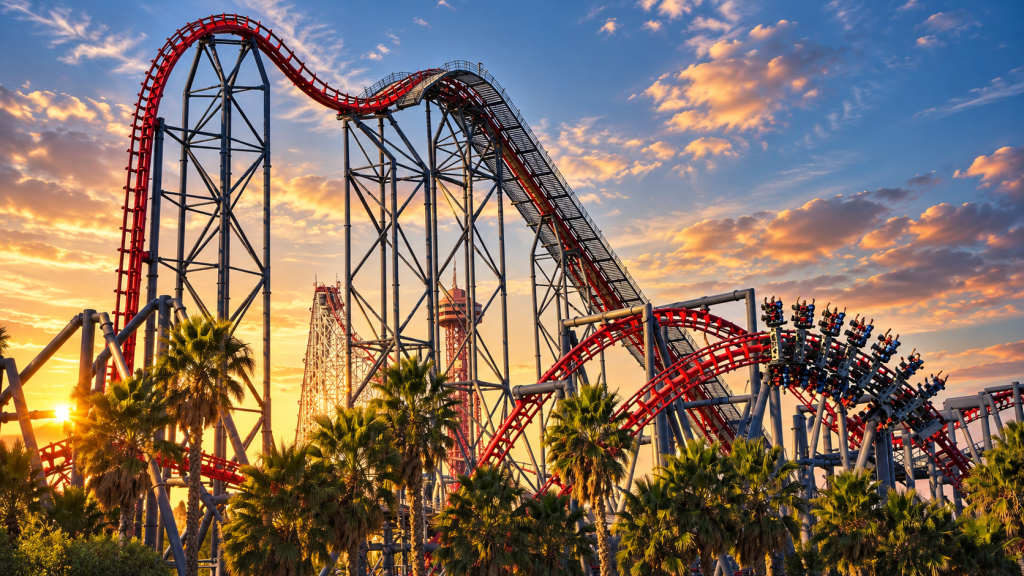
The track changed from its original yellow-and-purple appearance to the aggressive red-and-black look most coaster fans associate with X2 today.
Onboard audio blasted during the ride. Riders could encounter fog and other effects, and perhaps the most memorable addition was the pair of flamethrowers near the end of the course.
Because apparently being thrown around at 76 mph while your seat performs flips wasn’t enough.
Six Flags described X2 as a sensory-overload experience, complete with 360-degree rotating seats, face-down drops and two unusual raven turns.
It was completely ridiculous.
That was also exactly why people loved it.
X2 measured 175 feet tall, but because of Magic Mountain’s terrain, its first drop plunged approximately 215 feet at an 88.5-degree angle. The coaster reached 76 mph along 3,610 feet of track and subjected riders to forces approaching 4 G. Each train carried 28 riders in seven cars.
What Made X2 So Different?
Technically, the answer is the rotating seats.
Emotionally, the answer is everything.
Traditional roller coasters allow riders to anticipate what is coming. You can usually see the track ahead of you and understand which way your body is about to move.
X2 took that information away.
The seats were mounted outside the main track structure and rotated as the train navigated the course. Riders might be looking toward the sky one moment, staring directly at the ground the next and then flipping again while the train entered another element.
The coaster also featured two distinctive raven turns, elements that combined portions of a vertical loop with dramatic changes in direction. RCDB identifies both an inside and outside raven turn among X2’s signature elements.
And then there was that first drop.
The train climbed the lift hill backward before riders began rotating. Suddenly, instead of simply dropping down the hill, you were positioned face-first toward the ground as the train disappeared underneath you.
There are coaster drops.
Then there was the X2 drop.
A Prototype That Helped Change the Industry
X2’s influence may end up being just as important as the ride itself.
Arrow Dynamics built X as its prototype 4th Dimension coaster, and the concept eventually appeared elsewhere around the world. Fuji-Q Highland opened Eejanaika in Japan in 2006, while China Dinosaurs Park later opened Dinoconda.
The broader idea of placing riders outside the track and manipulating how they move independently also continued evolving. Modern 4D Free Spin coasters use freely rotating seats rather than the controlled rotation system found on X2, but they belong to the same unusual branch of coaster design that X helped introduce to the mainstream.
For more than two decades, X2 remained one of those rare rides where even seasoned coaster enthusiasts could get off wondering what exactly had just happened.
That is quite a legacy for a prototype.
Why Is X2 Closing?
This part of X2’s story is much more serious.
The attraction had already been closed since July 12 while California safety officials investigated incidents involving the coaster. Several lawsuits have also alleged that riders suffered serious injuries after riding X2.
Six Flags’ retirement announcement does not say that its inspections found X2 unsafe. In fact, the company specifically stated that the coaster had consistently passed numerous safety tests. However, Park President Brian Oerding said Six Flags decided permanent retirement was the right decision once guest confidence had been affected.
That distinction is important.
There are ongoing legal claims surrounding X2, and allegations made in lawsuits should not be treated as established findings about exactly what caused individual injuries. What is confirmed is that the coaster had remained closed during a state investigation and Six Flags has now decided it will not reopen.
So unlike the traditional coaster farewell where fans get several months to plan one last ride, X2’s final cycle appears to have already happened.
Fun Facts About X2
One of the coolest things about X2 is how many strange details are buried in its history.
Its Christmas Eve debut came before its official public opening. Season pass holders first experienced X on December 24, 2001, while the general public opening followed on January 12, 2002.
The ride was also truly a prototype. Arrow Dynamics had never built anything quite like it before, and the complexity of that design contributed to the challenges surrounding its development.
When X became X2 in 2008, Six Flags reportedly spent approximately $10 million upgrading an attraction that was already only a few years old. The transformation included lighter trains and new sensory effects rather than simply changing the name and painting the track.
Its trains were enormous compared with what you might expect from a coaster with such complicated vehicles. Seven cars carrying four riders each gave every train a 28-person capacity.
And according to Six Flags, more than 16 million guests experienced X2 following its 2008 transformation.
That’s an awful lot of people who probably walked off asking themselves what just happened.
One of My Wishlist Coasters That I’ll Never Get to Ride
This one stings a little more for me because X2 was one of those coasters sitting on my personal wishlist.
I’ve watched videos of it for years, seen that insane first drop, the rotating seats, the raven turns and the way riders seem to get tossed in directions that don’t even make sense from the ground. It always felt like one of those coasters I needed to experience at least once just to understand what all the hype was about.
Unfortunately, that ride is now never going to happen.
That is one of the frustrating parts of being a coaster fan. You can have a ride on your list for years, assuming you’ll eventually make the trip, and then suddenly the window closes. X2 was absolutely one of those bucket-list rides for me, and knowing I missed my chance makes its retirement hit differently.
I’ll never get to add X2 to my coaster count, but I can still appreciate what it brought to the industry. It was weird, ambitious, aggressive and completely unlike almost anything else ever built.
And honestly, that is probably why I wanted to ride it so badly.
There Will Never Be Another X2
That might sound dramatic, but this is one of those rare cases where it feels appropriate.
Could someone build another controlled 4D coaster? Absolutely.
Could someone build one taller, faster or smoother? Probably.
But recreating X2 would mean recreating a very specific moment in coaster history when manufacturers were willing to try something completely bizarre just to see whether it could work.
X2 had flaws. It could be aggressive. It certainly wasn’t everyone’s favorite ride.
But nobody could accuse it of being boring.
For coaster enthusiasts who traveled to California specifically to experience it, X2 was one of those bucket-list credits. It didn’t really matter how many roller coasters you had already ridden. Until you experienced those wing-mounted seats rotating over that first 215-foot plunge, there wasn’t much else to compare it with.
Six Flags Magic Mountain is already preparing for another major coaster chapter with its new Thrill Glider opening in 2027, a suspended multi-launch coaster featuring five inversions and more than half a mile of track.
But Thrill Glider isn’t replacing what X2 represented.
X2 belongs to a different era of coaster design: oversized, experimental, mechanically complicated and unapologetically strange.
More than two decades after X first started rotating riders beyond the edge of the track, the experiment is finally over.
And whether you loved every second of X2 or survived it once and decided that was plenty, the coaster world is going to feel a little less weird without it.